
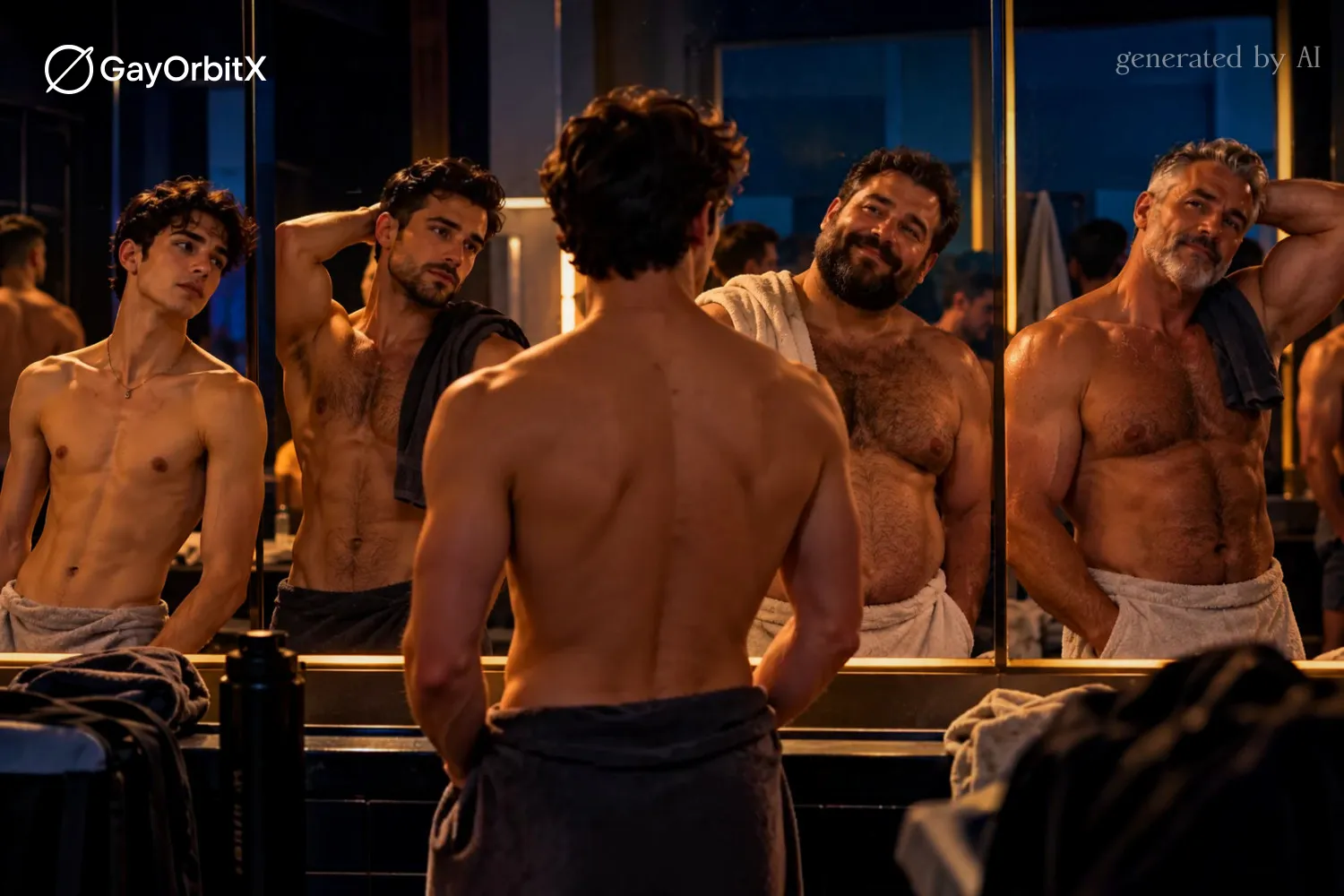
You open Grindr on a Monday morning. The first ten profiles – abs, V-lines, photos with no head but everything else. Somewhere between the eleventh and the twelfth you start wondering whether you’re good enough to send a message. Not to them. To anyone.
That isn’t paranoia. It’s an ecosystem. And we wrote it ourselves.
A Vocabulary of Desire, Not of Bodies
Let’s be honest: the gay community has done something fascinating. While straight lads are still at the ‘ooh, I fancy her’ stage, we’ve sorted male bodies into precise categories, given them names, flags and sometimes their own clubs. But to explain it properly, I have to start not with definitions but with what happens in the pit of your stomach when you walk into a room.
Twink. Young, slim, skin like silk, little or no hair. Often in jeans that hang lower than they should, or a T-shirt a size or two too small. He’s the first thing that comes to mind when someone outside our community says ‘gay bloke’. There’s something about him that turns people on – not just visually but energetically. Freshness. Innocence. He’s what many want to try, to taste, to remember their own youth by. But he’s also a target. Because a twink is often a product too – carefully chosen, waxed, branded. That’s why he can look as if it all comes easily, but that ease is sometimes the most expensive thing in the room.
Otter. Slim but hairy. Somewhere in between. Athletic, but without the theatrical gym look. He’s the type who’ll take his T-shirt off on the beach without noticing that everyone’s looking. A hairy stomach, a hairy chest, arms that look as if they do something useful. He’s attractive because he doesn’t seem to be trying. And that, in itself, is a kind of magnetism.
Jock. The sporty type, muscular but not overly so. Associations with changing rooms, wet hair, coaches who smell of Adidas and testosterone. He’s the one you watched in primary school and knew you must never look at for too long. Now you can have him. Or be him.
Muscle gay. Muscle daddy. A body that has become a temple. The gym as church, protein as communion wafer. They walk into a room and the temperature rises. It isn’t just muscle – it’s discipline, it’s control, it’s power you wear on yourself. And when you add years, when the silver beard appears along with that look that says ‘I knew before you did’, he becomes a daddy. And that authority turns people on. It turns them on because it’s secure. Because it doesn’t have to prove itself.
Bear. Big, hairy, masculine. He’s the answer to all of this. He’s a body that said ‘I won’t conform’ and became even sexier for it. The bear scene has its own culture, clubs, festivals. They’re proof that the gay world isn’t only the gym and calorie-counting. There’s beer too. There’s a belly too. There’s hair poking out of a T-shirt too. And that, sometimes, is the most erotic thing in the world.
Cub. A younger bear. Still growing into his fur. Still learning how to carry the weight. Sweet, but with the promise of becoming dangerous.
Dad bod. That magical space in between. A body that looks as if it once worked out, then discovered that beer and love matter more. And – this is important – it’s getting more and more popular. Because many people are tired of perfection. Many want to touch something soft, something human, something that breathes.
Chaser. Someone who’s attracted to bears, to bigger men. A term that exists because that desire isn’t ‘the default’. And that’s ridiculous – why should it be strange that a big body turns someone on? And yet we had to invent a word for it. Which says a lot about the kind of space we’ve made.
Who With Whom – and Why It’s Never Just Physics
Now that we have the vocabulary, it would be logical for each type to look for its own. But reality is messier, dirtier and far more thrilling.
One of the most common combinations is the muscle daddy and the twink. And that’s no accident. There’s a dynamic there that goes beyond skin. Experience against freshness. Protection against adventure. The one who knows against the one who’s still discovering. And it can be electric. It can be tender, it can be rough, but it’s always full. You’ll see them everywhere – from Grindr profiles to long-term couples who look as if they don’t belong together and actually belong together perfectly.
Bear and chaser are another classic pairing. A whole scene built around that attraction, with its own spaces, codes and identity. And there’s no room for shame. Quite the opposite.
Otter and jock often turn up together – similar energy, different aesthetics. Two bodies that look as if they might collide and actually fit perfectly.
Of course, chemistry works by its own rules. It rarely asks about categories. That’s why these patterns are only maps. And maps, as we know, aren’t the territory.
The Gym as a Second Coming Out – and as Revenge
Many gay men grew up as outsiders in sport. Bad at football, shut out of the changing rooms, ‘too soft’ for the playground. The body was a source of shame before it became a source of identity. And then – somewhere between eighteen and twenty-five – the gym.
And something changes. But what?
For some it’s health, routine, pleasure. For many it’s something more complex: revenge. Proof. Control over a body that used to be a target. That isn’t bad in itself – it’s understandable to the core. But it’s worth knowing why you lift weights. Is it for you, or is it a conversation you’re still having with someone from primary school who told you you were soft?
Because the gym has become the new moral imperative. You’re not a good gay man if you don’t go? You’re not a good gay man if you don’t have defined abs? It’s become almost a religious practice. And as in every religion, there’s guilt, confession and sin. You eat a slice of cake – the penance is an hour of cardio. You miss a workout – you feel as if you’ve let the community down.
And a body that doesn’t fit that mould? A body that’s soft, big, hairy, old, vulnerable? That body has to apologise. Or hide. Or find its own scene, its own app, its own corner where it’s allowed.
The Changing-Room Mirror: A Second That Lasts for Ever
There’s a moment everyone knows who’s ever walked into a gay club or a sauna, or opened an app.
You scan the room. Or the screen. And for a second – before reason kicks in – you make an assessment. Of yourself. Not of them. Of yourself in relation to them.
Am I enough? Would they look at me?
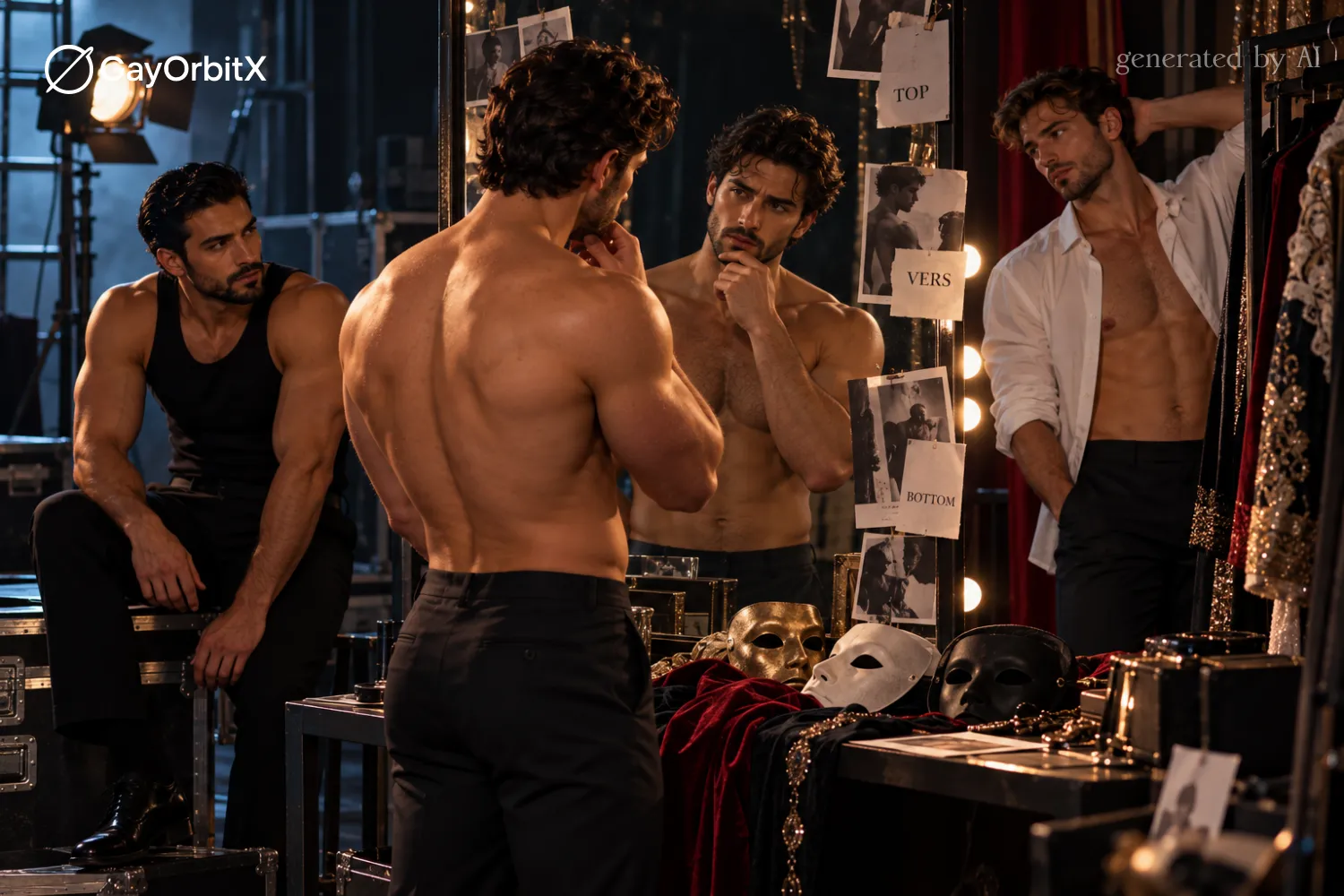
That isn’t a complex. It’s learned behaviour. Our spaces are, whether we like it or not, visual in a way that straight pubs mostly aren’t. The body is the first piece of information. Sometimes the only one.
And it isn’t necessarily bad – visual attraction is part of sexuality. But there’s a difference between being attracted to someone and feeling like an exhibit waiting to be marked. That difference is thin. And anyone who’s been on both sides knows it isn’t always clear which one you’re on.
‘Preference’ as a Comfortable Word
The straight world has types too. But somewhere in gay spaces it became more systematic, louder and sometimes ruder.
‘No fats, no femmes’ on a profile isn’t the same as ‘I like sporty guys.’ One is taste, the other is politics in small print. And although everyone has the right to be attracted to what attracts them – that’s genuinely so – there’s a difference between quiet preferences and public exclusion.
Apps have erased that difference. What would once have gone unsaid now sits in the bio section next to height and weight. And that’s become normal. But normal isn’t the same as right. And every time someone writes ‘only jocks’ or ‘no fem’, he isn’t expressing desire. He’s putting up a wall. And we’re so used to those walls that we no longer even notice them.
The Other End of the Spectrum
It isn’t all like that. The bear scene exists precisely as a reaction to that pressure – a space where a bigger body isn’t an obstacle but part of the attraction. Body-positive voices are getting louder, especially among younger people who grew up with a different vocabulary.
And there’s something lovely in the fact that the gay community has this vocabulary at all – that a twink is different from an otter, that there are scenes that celebrate different bodies. That isn’t insignificant.
But celebrating diversity while keeping a clear hierarchy – those are two things that live together, and a little uneasily. As if we’re holding two contradictions in the same breath and pretending not to notice that one is fighting the other.
Whose Standards Are You Trying to Meet?
In the end, to come back to what I said at the beginning. I know this vocabulary is useful. I know it’s good to know what turns you on and what doesn’t, where to go and where not to waste your time. But precisely because the vocabulary exists, so does the fear. The fear of not being good enough. The fear of belonging to no category, or of belonging to the one at the bottom of the wish list.
And that’s wrong. Not because everyone has to be attractive to everyone – that’s absurd. But because the culture imposes a particular shape and pretends it’s the only way. And it isn’t. For everyone there’s someone. For every body there’s a look that wants it. For every hair, every stretch mark, every kilo, every kind of muscle – there’s a hand that wants to touch it.
The question isn’t whether you’re good enough. The question is: whose standards are you trying to meet? And do those standards even suit you?
If you’re going to the gym tonight – go. But go for yourself. If you’re not going – don’t. And don’t feel bad about it. Your body isn’t a voice for someone else’s song. Your body is politics, yes – but politics you write yourself.
And if someone tells you you’re not good enough, remember: he isn’t talking about you. He’s talking about the limits of his own imagination. And that’s his problem, not yours.
Thanks for reading!
If this text meant something to you, support GayOrbitX: an independent portal, without censorship and without annoying ads. Your contribution allows us to write more and reach new stories in the field.
Do you love differently? Patreon (mesečna podrška), PayPal, Crypto



Comments
0 komentaraLeave a comment